https://www.smartsurvey.co.uk/s/YOUTHCONSULTATION/
- Section 75A makes provision for the new criminal offence of non-fatal strangulation and suffocation.
This offence will have general application and will apply to all cases where a person (D) intentionally strangles or suffocates another person (V), including cases where this offence occurs in a domestic abuse context.11
Strangulation and suffocation – GOV.UK
- Ministry of Justice Victim-survivor Support Needs Survey
This survey relates to sexual violence and other abuse. We have contact details for organisations that can provide support if you would like to use them. This link will be provided on each page of the survey.
To take part in the survey, please click the link below:
- Tip-off plan to expose wife beaters as Priti Patel prepares to announce national register of domestic abusers

Tip-off plan to expose wife beaters as Priti Patel prepares to announce national register of domestic abusers
- It will be announced by Home Secretary Priti Patel this week under other plans
- The move will involve the set up of the first national register of domestic abusers
- Whitehall insiders say it will mirror existing system that logs sex offenders
By MARTIN BECKFORD FOR THE DAILY MAIL
PUBLISHED: 01:31, 28 March 2022 | UPDATED: 01:35, 28 March 2022
Women will be alerted by the police if they buy a house or open a bank account with a convicted domestic abuser.
The move will be announced by Home Secretary Priti Patel this week under plans to tackle the growing problem of violence in the home.
It will involve the establishment of the first national register of domestic abusers.
Whitehall insiders told the Sunday Times that the proposal will mirror the existing system that logs the details of sex offenders.
The move will be announced by Home Secretary Priti Patel, pictured, this week under plans to tackle the growing problem of violence in the home
A similar system for the most serious domestic abusers would allow police to alert their partners to their offences at key ‘pathway points’ in their relationship.
This could include if they move in with a woman or open a bank account with them.
It would represent a major expansion of the current disclosure scheme known as ‘Clare’s Law’, which gives women or family members the right to ask police if a current or ex-partner has a violent or abusive past.
Police can also already alert women if they think their safety is at risk from their boyfriend or husband.

It will involve the establishment of the first national register of domestic abusers (stock image)
This week’s plans, due to be announced on Wednesday, will also see the Home Office launch a review into how criminal justice agencies share information about the risk a convict poses.
Funding for the 24-hour domestic abuse helpline, which receives about 15,000 calls a month, will be doubled to £2million while health services will be handed £7.5million to improve monitoring of the signs of abuse and sexual violence.
The moves come after domestic abuse cases rocketed during lockdown as vulnerable women were left trapped by domineering partners and unable to see doctors and social workers.
Latest figures show that police reports of domestic abuse rose by 6 per cent to 798,607 in the year to March 2021 while in the previous year, almost half of adult female homicide victims in England and Wales were killed by a partner or ex.
- Mayor Tracy Brabin launches West Yorkshires first Police & Crime Plan from Rosalie Ryrie Foundation putting women & girls first.
https://www.examinerlive.co.uk/news/local-news/west-yorkshires-first-police-crime-23349183
Metro Mayor Tracy Brabin has stuck by her manifesto pledge of putting the safety of women and girls at the centre of her first Police and Crime Plan.
The three-year strategy includes increasing police numbers and providing better support and justice for victims of domestic and sexual violence and hate crimes.ADVERTISING
The plans, which were developed with Deputy Mayor Alison Lowe, also include ensuring the police force is representative of the county’s communities.
People across West Yorkshire were consulted to set the direction for the new plans to hold the police to account.
The key aims of the plans, which cover 2021-2024, include:
- Expanding support services for victims of domestic violence, rape and sexual assault
- Improving prosecution rates for domestic abuse, sexual violence and hate crimes
- 750 more frontline police officers and police staff by May 2024
- Early intervention with those at risk of child sexual exploitation and county lines drug trafficking
- Reducing serious violence offences through the Violence Reduction Unit (VRU)
- Increasing cyber crime, including fraud, online abuse and exploitation, awareness and prevention
- Building resilience and reducing trauma for vulnerable people and those with complex needs

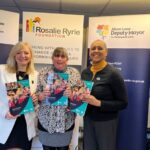
Brabin and Lowe with clients and staff at the Rosalie Ryrie Foundation (Image: YorkshireLive) Brabin and Lowe unveiled the plan from the Rosalie Ryrie Foundation in Wakefield yesterday (Thursday). The foundation supports both victims and perpetrators of abuse, as well as their children, to help them change their lives.
The foundation has worked with the VRU before and both Brabin and Lowe praised its work as reflecting their aims with the news policing plans, saying they were worth “every penny of investment”.
Tracy Brabin told YorkshireLive : “We’ve not been sat on our hands waiting for the Police and Crime Plan; we’ve already been investing in independent sexual violence advisers – 25 of those across the region; we’ve invested in a safety bus in Leeds at the weekend to support women who may not have money for a taxi or feel that they’ve been spiked or are vulnerable.
“We’ve also invested in programmes for safer parks – it can’t be right that women don’t feel safe in their parks. We’ve also invested in early intervention work for boys and men because it’s really important we change their behaviours to teach them what consent looks like and what is banter and what’s too far. Love is not harassing someone to force them to love you – that’s stalking and harassment.
“I am incredibly proud. And I don’t think this would have happened without a woman mayor and a woman deputy mayor. West Yorkshire Police have agreed to record misogyny as a hate crime – it’s not in law yet but setting that direction of travel is really important to show women are being heard in West Yorkshire.”
The plan also intends to address concerns around child sexual exploitation, anti-social behaviour, road safety, and making sure the police reflect the communities around West Yorkshire.
“After undertaking one of the biggest consultation exercises our county has ever seen, I know that it has the support of our communities and reflects what they want,” Brabin said.
“Devolution has given us control of the reins, which means we can now deliver for the people of West Yorkshire in a way which we have never done before.
“I see this as a once in a generation opportunity to focus our efforts on the issues which matter most to our communities.”
Lowe told YorkshireLive : “We’ve got a performance metric we can use to hold the police to account with things like positive outcomes for rape and serious sexual assault, the time it takes to answer 999 calls, the reoffending rate for domestic abusers.
“So that’s all in the plan and the metrics to hold the police to account – because we’ve listened to the voices of West Yorkshire and the police need to act.
West Yorkshire Police chief constable John Robins QPM said the force welcomes the new plans and is committed to playing its part.
He said: “Safety for women and girls is rightly at the centre of this plan. We continue to invest significant resources in understanding the issues that specifically concern women and girls.
- This Group Will Challenge Your Perception Of Men Who Abuse Their Families
Their stories vary: some have attacked their partners or children, others are controlling, and most struggle to manage their temper.
Some are classed as “high-risk” and their children have been placed under child protection so they don’t see them any more. Others have been told that if they don’t change their behaviour, they can’t go home to their families.
“Unfortunately, because people don’t realise there’s support out there until it comes to a certain point, a lot of them have had to leave, or their partners have left them,” says Ann Ramsden, the founder of The Rosalie Ryrie Foundation, the domestic abuse charity which runs the group.
For two hours a week, Ramsden works with the men to address aggressive and conforming behaviour. Social services are involved in many, though not all, of the cases.
Some, like Dave*, who is 37 and has been going to the group for 18 months, are not physically violent – they just want to stop shouting at their children.
At the start, Dave thought the group wasn’t for him.
“It seemed a lot of other people had a lot bigger issues than I had,” he says. “Some people had been in and out of prison, some are on drugs, some people have come off drugs, and some people are there because they’ve been violent to their partners.
“But if you keep going to the meetings, you find out that things affect people differently and people get put away because they reacted wrongly to something. I could have been in the same boat as what they are.”
Dave has had a volatile relationship with his partner in the past: “Just the general sort of shouting, and pushing now and again,” he explains. “Not violent as such in terms of punching each other or slapping or anything like that. Name calling, I’ve done that in the past.”
Looking back, he’d also describe the way he used to treat his six-year-old son as abusive. “Looking at the bigger picture, I’d say yeah. I think both me and my partner slapped him a little bit, not hard, just sort of when he was being wrong – but I’m dead against that.”
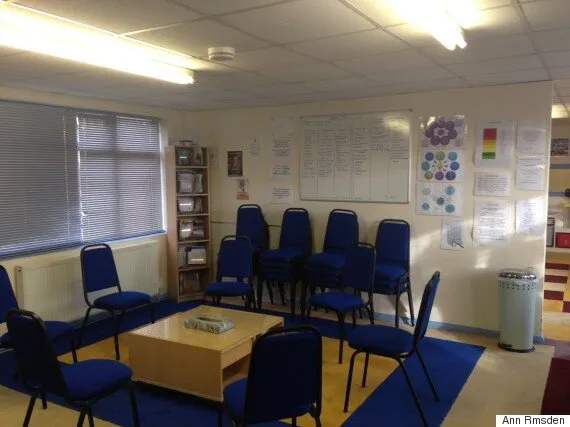
Room where the group meets His relationships with his family have changed since going to Rosalie Ryrie, but he is still concerned about “shouting and raising my voice” to his son.
His problems started after he had a child. “For the first couple of years, everything seemed to be ok and then me and my partner were falling out because we were arguing. There had been a couple of issues that I’d got: it’s a bit tricky to explain.”
Dave was abused by a female relative for several years, starting when he was around 10 years old.
“I remember her sort of messing with me down below. At the time I remember knowing it was wrong but I wasn’t sure what it really was, but when I spoke to people later on they are now saying that was abuse, and it shouldn’t have happened.”
“I didn’t forget about it, it’s always been there,” he says, “but it was just sort of left and forgot about.”
After his son’s birth, and hearing that a friend had gone through the same experience, Dave found himself breaking down and telling family members about the abuse. “Before I told them they said ‘Whatever it is, don’t worry about it, it’s not your fault,’ but when it came out that it involved family member, suddenly their reaction just sort of changed and it has literally been forgot about. It’s never been mentioned again.”
In her daily work with Rosalie Ryrie, Ramsden is aware of the complex reality of domestic abuse. Whole families participate in it, and almost every abuse perpetrator she has worked with – men, women and children – has also been a victim.
“A lot have gone through domestic abuse themselves as children; physical abuse, sexual abuse, anything that can impact on a child. Most of the perpetrators have got really low self-esteem,” she says.
“They’ve could have been bullied at school. Some taking on victim behaviors, but others become aggressive.”
So it isn’t as simple as treating an abuser as the bad guy, she explains: “You know when you hear the victim say ‘But he can be lovely’ or ‘she can be lovely’? And they are. Generally these are really protective, caring people, but they do it wrong.”
But she makes it clear that she doesn’t feel sorry for them: “We don’t go, ‘Aw, bless’. We get to a point so we can understand why that person may behave that way, but we don’t excuse any form of aggressive, violent or controlling behaviour.”

Ann Ramsden, with a picture of her mother Rosalie Ryrie behind her Men who are classed as a danger to their families pose no threat to the weekly group, she says. “A lot of people believe that. They say ‘oh god, you work with perpetrators.’ But they don’t kick off. It’s only within the home. They don’t come in here angry.
“I’m not here to judge them as a person, you know? And I think they realise that – I’m not here to say you shouldn’t be with your children, what I’m saying is your behavior is impacting on your family, it’s dangerous.”
Ramsden runs other groups alongside the men’s session, and says the perpetrators she sees are about 50/50 male and female. “Female aggressors find it more funny if they are aggressive to men. Men seem to be more ashamed of what they’ve done.” Some of the men are abused by their partners or even children, and Rosalie Ryrie also holds a group called High Heels for the growing problem of teenage girls being aggressive towards their family.
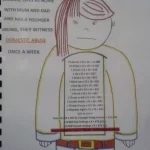
Understanding abuse through a child’s eyes is key to Ramsden’s approach. Men in the group are familiar with ‘Charlie’ – a tool she developed that uses a gender-neutral drawing of a child, to record all the abuse a child might see, overhear or experience in their life.
The group draw a ‘Charlie’ and note down events that might make him or her feel sad inside the drawing’s body.
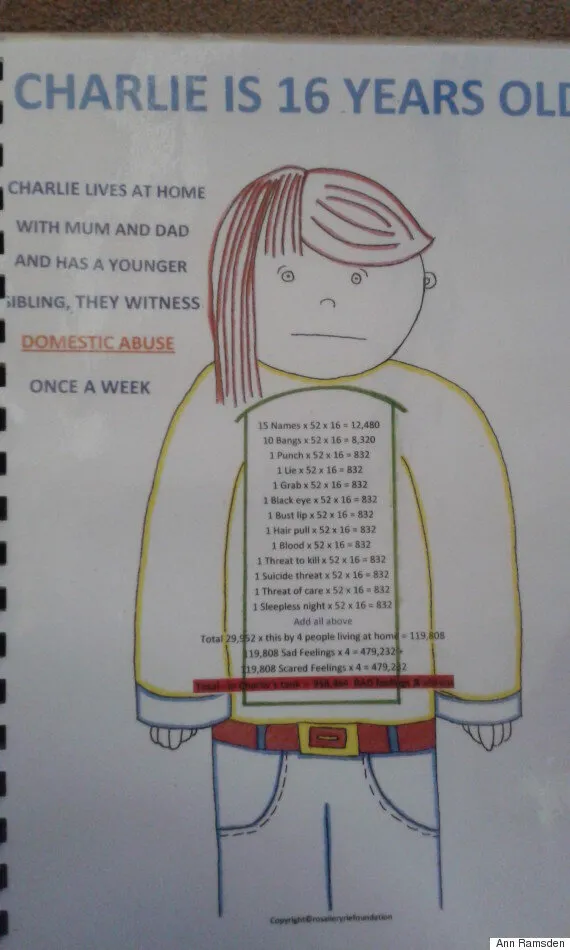
A ‘Charlie’ “It could be just ‘my dad got cross’,” she says, looking at a Charlie as she speaks to me. “We separate everything – we’ve got a domestic abuse incident, people who drink, people who use drugs, physical abuse, sexual abuse, divorce, separation, a new partner. We write each incident on – 15 names called, one kick, one punch…
“Then we add everything up. So if this Charlie is 16 years old, and he witnesses domestic abuse once a week, we times that by 52 weeks for 16 years to get a result. This Charlie that I’ve got in front of me has got 958,464 sad feelings.”
“It’s everything sort of inside that’s building up,” says Dave, “silly little things or big things that just keep building up and up and up, and if you don’t deal with them then it explodes.”
As well as thinking about how abuse affects their children, the drawing can also help them address the issues so many have from their own youth.
“People don’t understand themselves,” says Ramsden. “It’s like when people go through a death, they think ‘Yeah but he died 20 years ago’ but it still doesn’t mean they felt at that time. Most of the emotions we are carrying are from childhood. It’s not about an excuse, it’s that once we can understand this then we can work on it.”
The effects of Charlie on the group can be powerful. “Generally they break down. We get people crying in the room. Or go silent. Not a lot of people intend [to affect their kids when they fight with partners]. They think they weren’t there, or they were in a different room, then actually they can hear it – if you can hear neighbours, you can hear upstairs.”
Rosalie Ryrie is a tiny charity with only four members of staff, but helps nearly 200 people a year and is shortlisted for the Centre for Justice Awards due to be held in late November.
Ramsden named the charity after her mother, and founded it because of her own violent childhood. From aged 14 she abused her own father, verbally and physically, after her parents split up, “Then my mum’s new partner abused her, and my mum would bring me to come and attack him.”
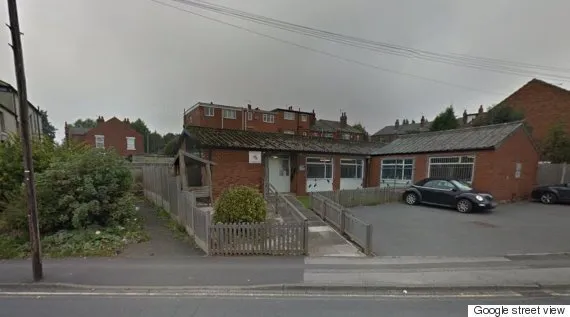
Rosalie Ryrie’s centre in Wakefield Ramsden sought help, but was frequently told someone would have to be arrested first before they could access any service, so she developed her own.
After a “volatile” relationship with a partner when she was younger, she now has a happy marriage and “did a lot of changing of my behaviour,” she explains. “That’s why I do what I do.”
In fact, she feels that her experience is an asset in dealing with the people who visit her groups: “They can’t manipulate a manipulator. Most of our workers have been through that so [the group members] can’t play games with us.”
Aside from Charlie, much of what the group does is simply talking about their feelings and how their week has been. “Some people can’t learn if you do it on a board, like a class class,” Ramsden notes.
She feels this relaxed, open approach is key to her success. “The proof’s in the behavior, because we’ve had feedback from other services. You can see a difference, not just in what they’re saying, it’s about feeling. Through observation of a person you can see if they are more relaxed. They might have been het up and frowning all the time, so you can visually see the changes.”
Dave also feels his behaviour has changed, though he still has more to do. “At the minute I would say it’s about 60/40,” he says. A few years ago, he would have told his son to hit back if he was bullied or tackled in a football match. But now, his response is different: “I say to him, if that happens, don’t kick out, just walk away.”
This shift resonates with Ramsden’s message that the whole family who need to be involved in combatting abuse. “Half of these guys we’re working with now as adults were somebody’s son who has gone some form of abuse,” she says. “They’re always somebody’s son.”
*Dave’s name and some details of his story have been changed to protect his identity
The Rosalie Ryrie Foundation is shortlisted for the Centre for Social Justice Awards 2015, which recognise UK charities that display innovation and effectiveness in addressing the root causes of poverty, transforming lives and reversing social breakdown. The Huffington Post UK is the media partner for the awards
- Wakefield Council to get hundreds of thousands of pounds for domestic abuse support

By Leanne Clarke Pontefract & Castleford Express
Wakefield City Council is in line to receive hundreds of thousands of pounds to help it provide support for domestic abuse victims and their children, figures reveal.
Wakefield City Council is in line to receive hundreds of thousands of pounds to help it provide support for domestic abuse victims and their children, figures reveal.
The money – a slice of the £125 million pot for all local authorities across England – will fund a new legal duty on councils to ensure victims can access vital services in safe accommodation, including refuges, as part of the Government’s domestic abuse bill
Safeguarding minister Victoria Atkins said providing safe accommodation for such services, including therapy, advocacy and counselling, will support survivors to “recover and rebuild their lives”.

Wakefield council to get hundreds of thousands of pounds for domestic abuse support A breakdown released by the Ministry of Housing, Communities and Local Government reveals £799,867 will be allocated to Wakefield City Council in the next financial year.
It is one of 120 “tier 1” authorities – larger councils which will receive the bulk of the funding and be expected to create partnership boards, which bring local services together, as well as assessing victims’ needs.
They will work with smaller “tier 2” councils to carry out their new obligations, the MHCLG said.
Initially announced during the Spending Review in November, the multi-million-pound fund for councils is a key element of the bill aimed at giving better protection to those fleeing violence.
But the Local Government Association, which represents local authorities in England, said while it is a “step in the right direction”, further investment is needed elsewhere to transform the response to domestic abuse.
Nesil Caliskan, chair of the LGA’s safer and stronger communities board, said: “A joined-up approach is needed, providing a broad range of support packages to assist victims and intervene with perpetrators to change and prevent their behaviour.
“While this first year of funding for the new statutory duty is positive, and there is a commitment from the Government to continue to fund the duty in future years, this should be a multi-year settlement that provides adequate and long-term resources to local authorities.”
The domestic abuse bill, which is currently before MPs, will also introduce the first legal government definition of domestic abuse, including economic abuse and controlling and manipulative non-physical behaviour.
Home Office data shows 18% of all crime recorded by West Yorkshire Police involved domestic abuse in the year to March 2020, with 52,696 such crimes recorded.
Of those, 14,182 involved stalking and harassment, while 2,115 coercive control incidents were reported.
Tracy Blackwell, head of development at domestic abuse charity Refuge, said while the funding was welcome research by Women’s Aid suggested an additional £48 million would be needed each year to meet demand.
“We hope it will go some way to ensuring local authorities can provide adequate, sustainable funding for refuges in their area. However, we know that more can be done,” she said.
“Refuge is calling for sustainable, ringfenced funding and for the government to urgently commit to the £173 million needed to increase the number of refuge spaces available, which currently falls 30% below the minimum number recommended by the Council of Europe.”
Minister for rough sleeping and housing Eddie Hughes said: “Domestic abuse is a heinous crime which threatens the lives of victims in their own homes where they should feel safe.
“It’s right that we’re giving victims support in safe accommodation and providing councils with money to deliver essential services that will help them and their children rebuild their lives.
“This is part of a long-term strategy to provide broader support for domestic abuse victims both in safe accommodation like refuges, and in their own homes.”
- Ann’s Second Book

Ann is currently writing her second book which enables professional and parents to understand children working with insight, “Through the eyes of a child”.
Photo of Ann Ramsden Founder and Manager of the Rosalie Ryrie Foundation on panel at Oxford University to discuss findings on research into Adolescent to Parent Violence.
BBC Radio Leeds – Richard Stead – 10th March 2015 Minutes 8-20 approx
Difficult parenting decisions – A mother and daughter tell their story of child to parent abuse.
- THE ROSALIE RYRIE FOUNDATION IS HONOURED TO HAVE RECEIVED THE QUEENS AWARD FOR VOLUNTARY SERVICE 2018

For a full list of winners and further information go to www.gov.uk/dcms
The Rosalie Ryrie Foundation has worked tirelessly for the past 10 years staffed predominantly by volunteers. This award is an honour and a privilege for the foundation but specifically acknowledging the hard work of the volunteers, year after year.
Well done to everyone involved !! #QAVS2018
- VIOLENT CHILD – DESPERATE PARENTS
http://www.channel5.com/show/violent-child-desperate-parents
Further information on the Adolescent to parent violence project run by Oxford University featuring Rosalie Ryrie Foundation.
The Rosalie Ryrie Foundation features in both films.
Home Office Information Guide :
The Rosalie Ryrie Foundation is included in the Home Office Information guide: adolescent to parent violence and abuse (APVA). How to Respond to APVA: General Advice for all Practitioners: Health Professionals, Education, Social Care, Housing, Police, Youth Justice.
The cross-Government definition of domestic violence and abuse is any incident or pattern of incidents of controlling, coercive or threatening behaviour, violence or abuse between those aged 16 or over who are or have been intimate partner or family members regardless of gender of sexuality. This can encompass, but is not limited to psychological, physical, sexual, financial and emotional abuse. While this definition applies to those aged 16 or above, APVA can equally involve children under 16, and the advice in this document reflects this.
It is important to recognise that APVA is likely to involve a pattern of behaviour. This can include physical violence from an adolescent towards a parent and a number of different types of abusive behaviours. Violence and abuse can occur together or separately. Abusive behaviours can encompass, but are not limited to humiliating language and threats, belittling a parent, damage to property, stealing from a parent and heightened sexualised behaviours. However some families might experience episodes of explosive physical violence from their adolescent with fewer controlling , abusive behaviours. Although practitioners may be required to deal with a single incident of APVA, it is important to gain an understanding of the pattern of behaviour behind an incident and the history of the relationship between the young person and the parent.
- My Violent Child – Channel 5
http://www.channel5.com/shows/my-violent-child/episodes/my-violent-child-tearing-us-apart
Preston mum Tracey has suffered from violence at the hands of nine-year-old Robert since he was three, and the problem is progressively getting worse. Their house is riddled with holes that he has punched in the wall and in the past the police have even had to use riot shields and tasers to control Robertʼs rages. Now that he is getting older, Tracey is terrified of what he is capable of doing next. As Robert says: “It feels like someone else taking over my body when I get angry.” The programme also tells the moving story of eight-year-old Bailey. He has been diagnosed with ADHD and does everything he can to control his anger, but cannot help lashing out at his parents.
The programme follows both families on their emotional journey as they try very different approaches to solving their childrenʼs behavioural issues. Tracey works with parenting expert Ann Ramsden, who quickly gets to the heart of the problem, realising that witnessing violence at a young age has had awful repercussions. Meanwhile, Bailey and his parents work with ADHD counsellor Lorrine Marer, whose confrontational style of anger management has immediate effects, allowing Bailey to explain the heart-wrenching story of what really lies behind his anger.